17 Mar 2026




 Back
Back

How Many Seats Does a Bus Have?
- Tata Motors
- 4 Dec 2025
- COMMERCIAL VEHICLE
- Share
-

-

-

-

-

Introduction
Whether planning for daily commutes or travel and tourism, the key consideration often comes down to a bus's seating capacity. This is because it determines the number of trips required and the operational efficiency achieved with each journey. Since buses have different seating capacities, this blog delves deeper into the topic.
Understanding Buses
Buses are the backbone of group transportation, whether it's public transit, school runs, or cross-country tours. Their ability to transport large groups on a single trip makes them a practical choice for fleet operators and a cost-effective solution for users.
However, here's the thing: the number of seats on a bus isn't always the same. The bus's size and design influence it.
What sets Tata Motor's buses apart? Several factors. The bus is designed and engineered with practicality at its core. Its generous dimensions provide ample space, while its seating capacity allows a substantial number of passengers to be accommodated per trip.
Furthermore, all Tata buses have ergonomic seats, allowing the passenger to adjust it as per their preference. The buses are also equipped with large, paneled windows, allowing passengers to enjoy clear views of the surroundings throughout the journey.
Importance of Knowing the Seating Capacity
Understanding how many seats in a bus you'll need shapes how you can plan group travel properly. It helps maintain a pleasant onboard experience while avoiding overcrowding. The exact bus seat capacity, length of the bus, and number of doors depend on the make, design, and purpose of the vehicle.
While some focus purely on volume, others are configured to prioritise the rider's experience. In regions like the Middle East, where heat and distance amplify the need for comfort, choosing the right configuration is non-negotiable.
Standard Bus Seat Size Layouts & Configurations
Each bus manufacturer offers multiple bus seat capacity layouts to meet different customer needs. How many seats in a bus can you actually expect? Below are some typical configurations and their bus seat capacity:
-
Minibuses: 24-28 passengers
-
Midi Buses: 33-40 passengers
-
Large Buses: 54-70 passengers
So, depending on your group size and comfort expectations, your bus choice can change widely.
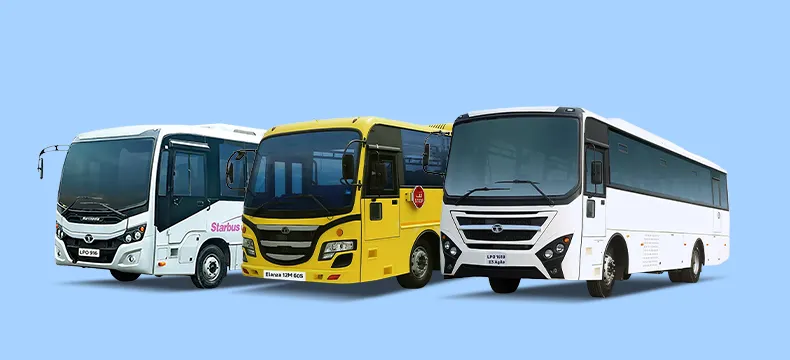
Buses Offered by Tata Motors:
-
LPO 916
The Tata LPO 916 serves various needs, from daily school routes and employee shuttles to light tour operations.
What makes this possible is its best-in-class aggregates, the 697 TCIC Euro IV Engine, G600 OD 6F+1R Gearbox, the Dual circuit full air S-cam brake with Anti-lock Braking System.
Each of them performs its role with precision and contributes to the vehicle's overall performance.
The Tata LPO 916 has a seating capacity of 33 + D. This enables fleet operators like you to seat a good number of passengers per trip, improving operational efficiency.
-
ELANZA LPO 1618 62WB SCHOOL
The Tata LPO 1618 Elanza is powered by the reliable Cummins ISBe 5.9 E-IV engine that produces 180 HP and 690 Nm torque. This allows the bus to operate without a hitch, which is especially important when adhering to strict school schedules
Furthermore, what sets this model apart is its safety-first design. It features high-back bus seats, 3-point seat belts, surveillance cameras, fire suppression systems, and strategically located emergency exits.
All these features make it a trusted companion for daily school routes, where the safety of children is paramount.
-
LPO 1618
The Tata LPO 1618 meets every key requirement a fleet operator may have for a bus. For instance, as a fleet operator, you need to maximize operational efficiency per trip while ensuring passenger comfort. The Tata LPO 1618 delivers on this with its spacious interiors and impressive seating capacity.
From a customer experience standpoint, it ensures consistency and reliability. The bus operates smoothly day in and day out, ensuring passengers are never stranded and reach their destinations on time. Additionally, it is equipped with advanced safety features that allow passengers to travel with complete peace of mind.
Conclusion
Knowing the seating capacity of your bus isn't just a minor detail; it's the foundation of effective planning. It gives you an idea of how many trips are required to accommodate your target number of passengers.
It also helps you determine the ideal number of passengers per trip to ensure maximum comfort. All these factors are essential for scaling your business systematically while maintaining high levels of customer
Tata Motors Middle East offers an impressive range of buses, each built to be capable and reliable, supporting your operations end to end. Visit your nearest Tata Motors dealership to explore all available options and drive your business forward today!
FAQs
-
How does the size of the bus factor into the number of seats?
Yes, the size of a bus directly affects the number of seats it can accommodate. Generally, larger buses tend to offer a higher seating capacity.
-
What is the usual bus seat layout?
The most common is the 2-2 layout, balancing comfort and capacity, followed by 2-3 for maximised seating on school or city buses.
-
Are there buses with no seats?
Some specialised buses, like cargo transporters or modular utility buses, may be designed without seats.
- Tags
-

-
About the Author
Tata Motors
Tata Motors Group (Tata Motors) is a $45 billion organization. It is a leading global automobile manufacturing company. Its diverse portfolio includes an extensive range of cars, sports utility vehicles, trucks, buses and defense vehicles.
Latest Blogs